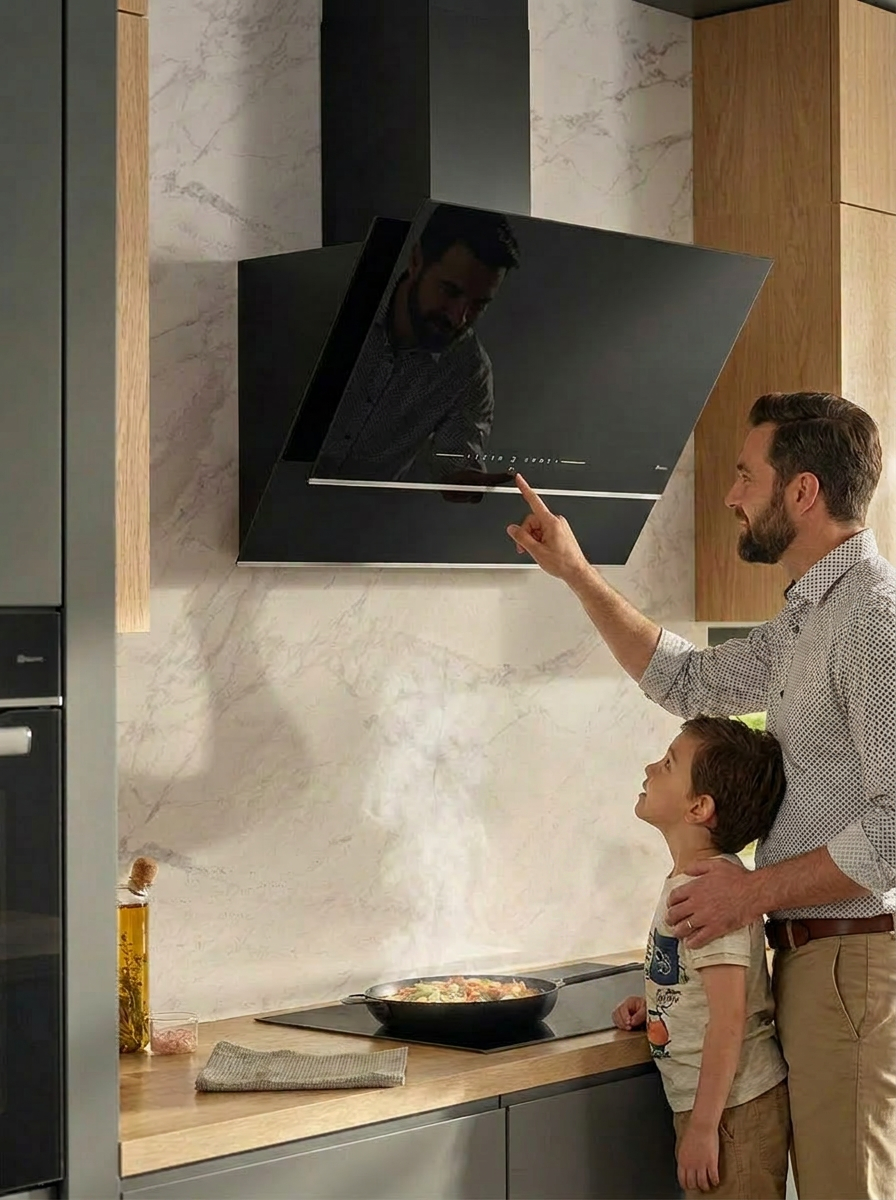
A good hood is not the most striking one: it is the one that extracts the necessary air without making noise in your particular kitchen.
The hood is one of the most underrated appliances in the kitchen. Before looking at the design, answer two questions: do you have an air outlet to the outside or will you have to recirculate? Is the hob against a wall or on an island?
Calculate the power you need
The minimum airflow is calculated by multiplying the volume of your kitchen (width × length × height) by twelve air changes per hour. The result in m³/h is the minimum power. If the kitchen is open to the living room, adjust upwards.
Types by installation
For hobs against the wall: vertical, inclined or horizontal decorative hoods, or pull-out modules hidden in the upper cabinet. For island kitchens: ceiling hoods, suspended hoods with a central flue, downdraft extractors that rise at the touch of a button, or hobs with integrated extraction.
Exterior outlet or recirculation
An outlet to the outside always performs better: it draws in the fumes and expels them outdoors. Recirculation passes the air through activated-carbon filters and returns it to the kitchen; it is the only option when no duct can be fitted.
Noise and conveniences
Between 40 and 60 dB, operation is comfortable; above that it becomes annoying. The larger the hood body, the less noise at equal power. An ambient sensor that automatically regulates the power is a very convenient feature.
Common mistakes
- Choosing on looks alone and forgetting the free height you will have under the hood while cooking.
- Forgetting the duct and the outlet bends: every tight bend reduces the real airflow.
- Not cleaning the aluminium filters (they go in the dishwasher): a saturated filter cancels the extraction.