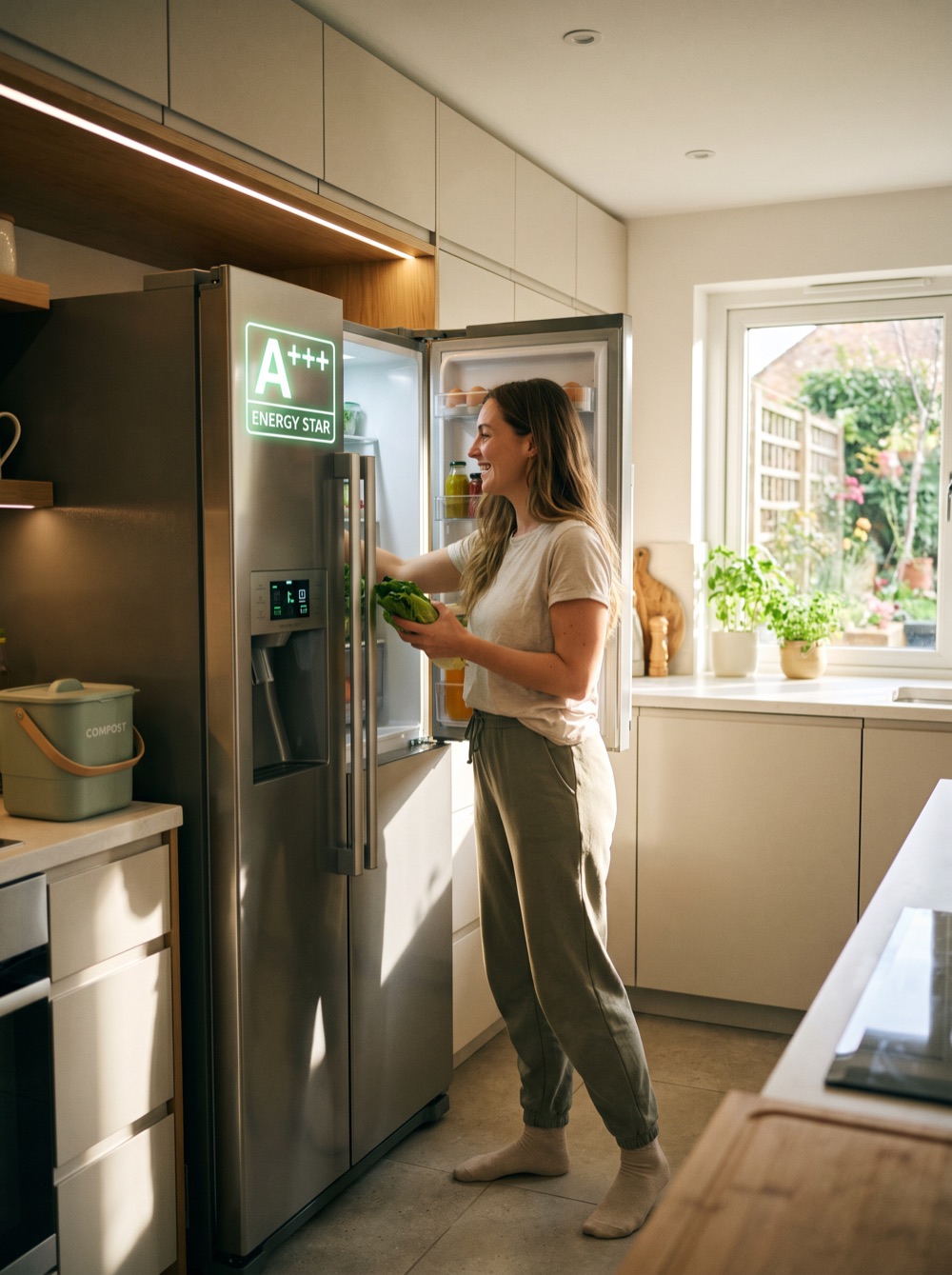
Every appliance carries one and almost nobody reads it in full. It is the only sheet that compares two appliances by the same criterion.
The energy label is mandatory across the European Union and is filled in by the manufacturer following a standardised test: the same programme, the same load and the same laboratory for all brands. That is why it is the only figure on the technical sheet that can be compared directly between one appliance and another.
The A–G scale
Since March 2021 the scale went back to A to G, without the old A+, A++ and A+++. It was not a name change: the requirements were rescaled, so an appliance that was A+++ on the old scale now usually lands on a C or a D without anything having changed inside. The A was deliberately left almost empty to make room for the technology to come.
This has a practical consequence: a class A washing machine today is much more efficient than an A+++ from a few years ago, and comparing the letter in an old catalogue with one in a new one says nothing. Always compare labels on the same scale.
Consumption, in kWh
Below the letter comes the figure you actually pay: consumption in kilowatt-hours. For refrigerators it is per year; for washing machines, dishwashers and dryers, per 100 cycles. To convert it to euros, multiply by what a kWh costs you.
Watch the test reference: the consumption of a washing machine or a dishwasher is measured with the Eco programme, which is the longest and the most efficient. If you always use the quick programme, you will spend quite a bit more than the label says.
The pictograms
To the right of the letter there are four or five icons that change with the appliance: load capacity in kilos, litres of water per cycle, programme duration, litres of the fridge and the freezer, and noise.
Noise is given in decibels and with a letter from A to D in its own box. In a kitchen open to the living room that letter weighs as much as the energy one: below 45 dB a dishwasher doesn't disturb a conversation.
The QR code
At the top right, the QR leads to EPREL, the official European database. There you will find the complete data sheet of the model, with more information than fits on the label, and it serves to check that the appliance you are being offered is exactly what it claims to be.
Common mistakes
- Comparing an old A+++ with a current A: they are two different scales and don't mean the same.
- Paying much more to go up a single letter on a rarely used appliance: it pays off in a freezer that runs all year, almost never in an occasionally used dryer.
- Forgetting noise in open kitchens: it is the figure you notice most every day and the one looked at last.
- Taking the advertised consumption for granted while using quick programmes: the test is done with the Eco programme.